



Negotiations
| Older Posts |
 |
 |
Many (Or Most?) Home Sellers Prioritize Certainty Over Price |
|
 When a seller signs a contract with a buyer, they want to be as certain as possible that the contract will proceed to settlement. The king of all offers, providing the most certainty to a seller would be a cash offer with no contingencies whatsoever. As each of the contingencies below are added to a contract, the seller's certainty decreases...
It is important, as a buyer, to remember that most sellers are thinking about certainty alongside price. Which of these offers is likely to succeed?
When presented with these three offers I think many or most sellers would choose offer #1 even though it is $1K or $5K lower than the other two offers in hand. Give careful thought to the contingencies you do and do not include in your offer and understand how they affect the seller's view of the certainty that your contract will make it to settlement. | |
 |
 |
|
|
Another Buyer May Be Able Or Willing To Pay More Than You |
|
 Many homes in many price ranges are still receiving multiple offers. Thus, a variety of questions may run through your mind if you are making an offer on a popular new listing... [1] How much is this home worth? [2] How much am I willing to pay for this house? [3] Will I win the bidding war? The challenge in answering #3 above is often not in the answer to #1 but in other buyer's answer to #2. It's note quite this black and white, but let's pretend that you and the three other buyers who are making an offer all conclude that the home is worth $350K. You love the house but your budget is capped at $360K. You offer to pay up to $360K. The second buyer won't pay a dime over market value, so they offer $350K. The third buyer has a budget that goes up to $500K, so they are willing to pay up to $370K for the house. Depending on the other terms of the offer, the third buyer is likely to secure the contract on the house. As another example... Let's again pretend that the home in question is worth $350K, but it needs some updates. You love the house, but given the need for some updates you are not comfortable paying more than $350K. The second buyer offers $340K because of the need for updates. The third buyer is super handy and will make all of the updates themselves and has plenty of cash to spare for supplies, etc., so they offer to pay up to $360K. Again, depending on the other terms of the offer, the third buyer is likely to secure the contract on the house. In any given multiple offer scenario, you must remember (as a buyer) that other buyers might be able or willing to pay more than you. | |
|
|
|
|
The Differential Value In Your Escalation Clause Should Likely Vary Based On The Other Terms Of Your Offer |
|
 We're still in a housing market where many new listings will have multiple offers within a few days -- not all new listings, and maybe not most -- but many. As such, if you are hoping to buy a home this spring or summer you may find yourself competing against another buyer (or buyers) when you make an offer. If you are making an offer, and competing against one or more other offers, you may find yourself including an escalation clause in your contract. How does an escalation clause work, you might ask? An escalation clause allows you to make an offer at one price but include offer terms that will automatically increase that offer if another offer is at a higher price point. For example... offering $325K... but automatically increasing your offer up to $340K if there is another higher offer. One missing element of the description above is the differential value in your escalation clause. Here are two different versions of the escalation clause above, with differential values... [1] Offer of $325K, automatically increasing to be $1K above other offers, up to a maximum of $340K. [2] Offer of $325K, automatically increasing to be $5K above other offers, up to a maximum of $340K. Let's say, for illustrative purposes, that you are (unbeknownst to you) competing with an offer of $330K. The first escalation clause above [1] would cause your offer to be $331K. The second escalation clause above [2] would cause your offer to be $335K. Why would you include a differential of $1K vs. $5K vs. something even higher? Oftentimes, it depends on the other terms of your offer. If you are making a very clean offer with an 80% financing contingency, no home inspection, no home sale contingency and a speedy proposed settlement... you might just include a $1K differential in your escalation clause. The thought or hope in this instance is that your offer terms (other than price) will be equal to or better than the competing offer, and that your offer being $1K higher is enough of a difference to hopefully cause the seller to accept your offer. If you are making an offer with a smaller downpayment (95% financing), and with an inspection contingency... and if you suspect you are competing against buyers with larger downpayments or without inspection contingencies... you might include a larger differential in your escalation clause. The thought here is that if your offer with an inspection contingency is only $1K higher than a competing offer without an an inspection contingency, the seller will likely accept the other offer... but if you are offering (via the differential in your escalation clause) a price that is $3K (or $5K) higher than the competition, maybe that differential will be enough to cause the seller to still consider your offer despite the inspection contingency. And so on and so on. If you are proposing a delayed settlement date, increase the differential. If you have a home sale contingency as well, increase the differential. You can't know the details of the terms of the offer with which you are competing... but you can be strategic about how you craft the terms of your escalation clause based on the other terms of your offer. | |
|
|
|
|
How Many Homes Are Selling For Less Than The List Price? |
|
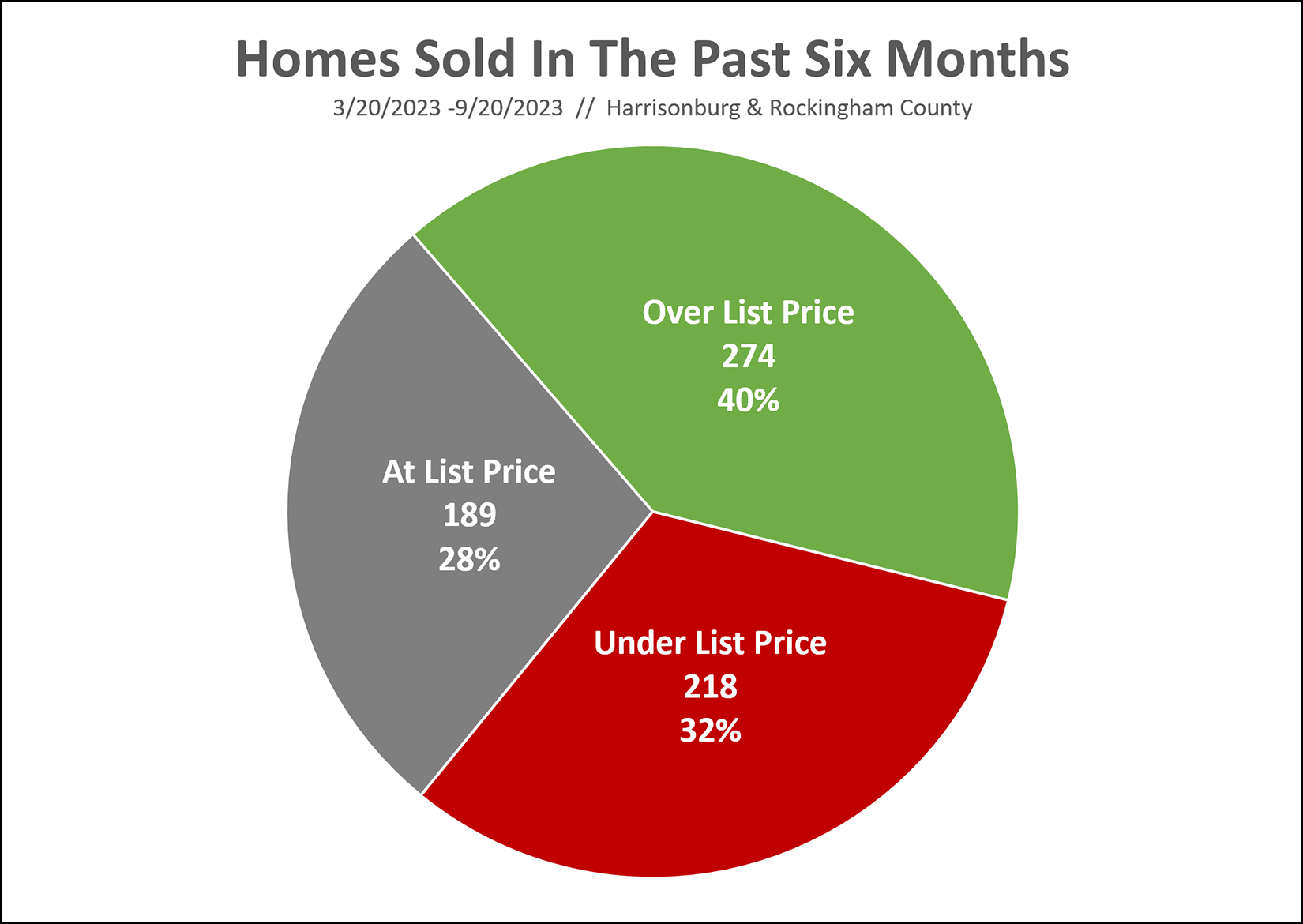 If we look at homes that have sold in the past six months... [1] 68% have sold for the list price or higher. [2] 32% have sold for less than the list price. [3] 40% have sold for over list price. Maybe several of these stats surprise you. Maybe none of them do. I think the most surprising to me is that 32% of homes sold for less than the list price. If often feels like buyers are barely ever able to negotiate on price -- and sellers are barely ever willing to negotiate on price. Interestingly, let's look back a year and a half (ish) to 2021 when mortgage interest rates were in the 3.something range... 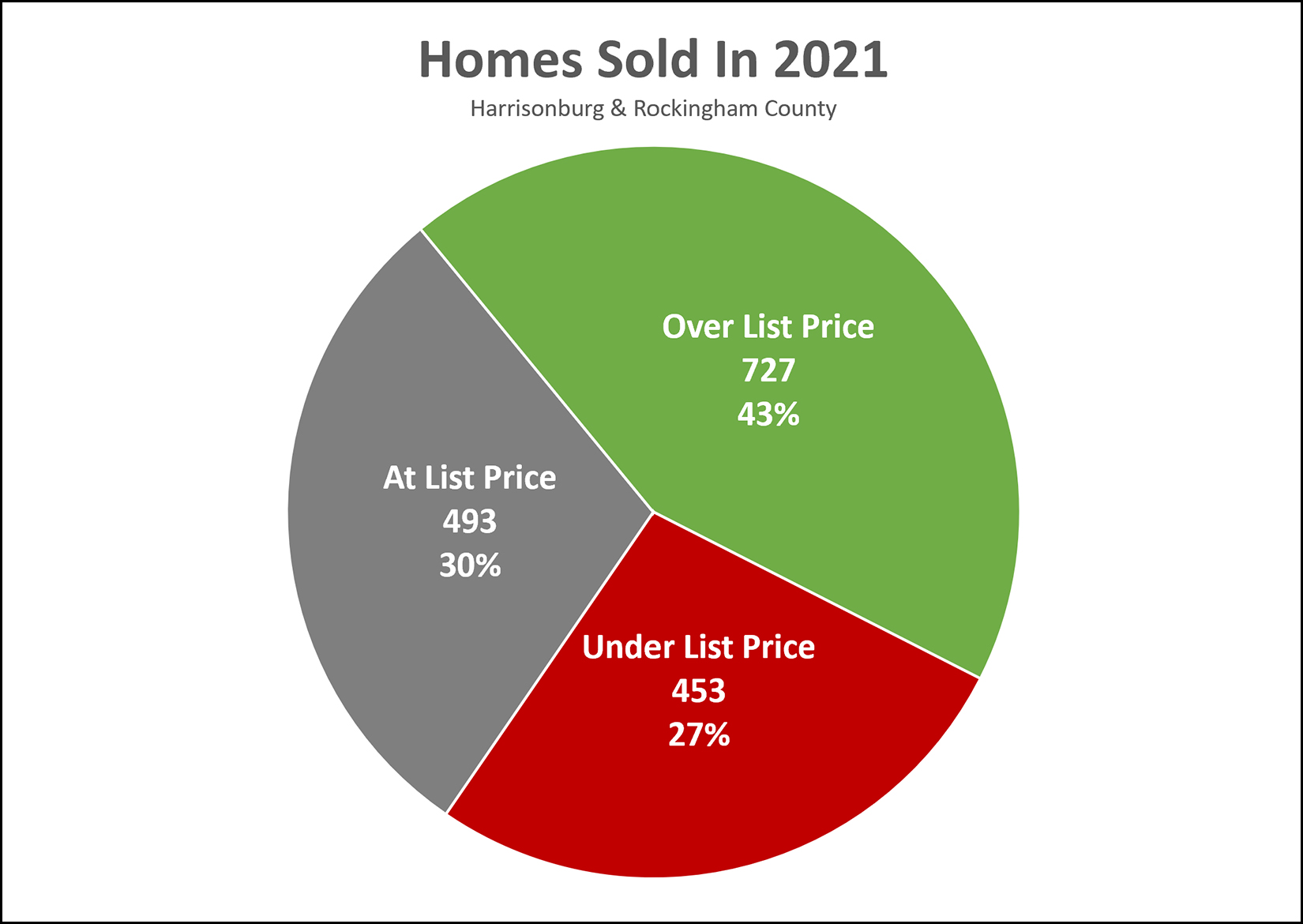 The numbers here are certainly different, though not quite as different as you might imagine. For all the homes that sold in 2021... [1] 73% sold for the list price or higher. [2] 27% sold for less than the list price. [3] 43% sold for over list price. So... is every home selling over asking price? Nope. Back in the crazy times of 2021, was every home selling over asking price? Nope. | |
|
|
|
|
If Your Offer Is Competing With Other Offers, You Should Max Out Your Preapproval Letter |
|
 A few (4+) years ago, most offers were made without having to compete with another offer. In such as a circumstance, it often made sense to tailor your preapproval letter to match the price you were offering. For example... $275,000 = List Price $350,000 = Your Max Preapproval Amount $265,000 = Your Offer $265,000 = The Preapproval Letter You Include After all, why let the seller know that you could pay $350K when you're trying to negotiate them down from $275K to $265K. :-) These days, however, things work a bit differently. You should consider maximizing the amount of your preapproval letter to show your financial strength. $350,000 = List Price $475,000 = Your Max Preapproval Amount $375,000 = Your Offer (after escalating) $475,000 = The Preapproval Letter You Include Yes, you could certainly include a preapproval letter from your lender showing you are qualified to pay $375K for the house -- but the strength of your finances will be much more evident to the sellers if you include the maximum preapproval letter of $475,000. So... in a competitive offer scenario, don't hide the top price you can afford, as it might sway the seller in your favor as they are considering multiple offers. Most sellers, if presented with these three offers would choose the third offer... [1] Offer of $375,000 with pre-approval letter of $375K [2] Offer of $375,000 with pre-approval letter of $395K [3] Offer of $375,000 with pre-approval letter of $475K As a side note -- even if you don't want to spend $475K, and you won't spend $475K, if you qualify for $475K it can still be helpful to have that letter from your lender for the reasons outlined above. | |
|
|
|
|
The First Buyer To Make An Offer Will Likely Not Include An Escalation Clause, At Least Not At First |
|
 Yes indeed, we're still in a market where we often see multiple offers on new listings... and when there are multiple offers, we are likely to see some escalation clauses. If you are selling one of these popular new listings, should you expect that the first offer you receive will have an escalation clause? Probably not. Here's why... An offer only needs an escalation clause if it is in competition with another offer... and thus, if a buyer is making the first offer, the escalation clause is not needed. For example, if a house is listed for $325K, an interested buyer might offer $325K - but they are unlikely to offer $325K with an escalation clause going up to $350K. Why not include the escalation clause up front? If the first offer a seller receives includes an escalation clause, they are almost certainly going to be motivated to... wait for other offers. If your home is listed for $325K, and you have eight showings lined up, and the first buyer to see the house makes an offer of $325K that escalates to $350K -- you'll want to wait to see if you have any other offers, hopefully above $325K, that would cause that escalation clause to kick in. Now, certainly, that first buyer will want the opportunity to consider adding an escalation clause if or when there is a second offer with which they are competing. Thus, they may ask to be notified if any other offers are received -- and it would make sense for a seller to give them a heads up if or when a second offer is received. So... BUYERS: You likely don't need to have an escalation clause in your offer if you are the first buyer to make an offer -- but you should be ready to adjust your offer (to add one) very quickly if/when you hear that there is a second offer. SELLERS: Don't be surprised if the first offer you receive does not include an escalation clause. Likewise, don't be surprised if those buyers add an escalation clause once a second offer exists. | |
|
|
|
|
In A Multiple Offer Scenario, Consider Making The Strongest Offer You Are Comfortable Making |
|
 It seems we might still be finding ourselves in plenty of multiple offer scenarios this coming spring in the Harrisonburg and Rockingham County real estate market. And sometimes... a buyer discovers that the house they have just walked into is one that works very, very well, for their needs. What sort of an offer should that interest translate into? I recommend that buyers make the strongest offer that they are comfortable making. PRICE - If the house we just viewed is listed for $400K, and we believe it is worth $400K, perhaps we offer $400K. Or, perhaps we include an escalation clause to demonstrate a willingness to pay as much as $410K, or $425K, given that this property fits your needs (and wants) very, very well, like no other house has to date. INSPECTION - If you are comfortable making an offer without a home inspection, based on your level of risk tolerance, and the condition and age of the property, and your available resources for making improvements, then perhaps we make an offer without an inspection contingency. Or, perhaps you are not comfortable making an offer without an inspection contingency. RADON - If you are comfortable testing for radon after you purchase the home, and installing a radon mitigation system at that time if needed, then perhaps we make an offer without a radon test contingency. APPRAISAL - If, based on the size of your downpayment, a slightly low appraised value would not affect your financing, and if you are comfortable paying the offering price regardless of what value the appraiser determines through their appraisal process, then perhaps we make an offer without a specific appraisal contingency. As you can see here, if we are going to be competing with other buyers and offers, we need to make a strong offer, but only as strong as you are comfortable making given your financial picture, the particular property, how well the property suits you, your tolerance for risk, etc. | |
|
|
|
|
An Appraisal Contingency Should Not Worry Most Home Sellers |
|
 For a few years now, in a highly competitive seller's market, buyers were waiving contingencies left and right... No Home Inspection Contingency! No Radon Test Contingency! No Appraisal Contingency! No Home Sale or Home Settlement Contingency! Now, though, with much higher interest rates, and somewhat lower levels of buyer interest, we are sometimes seeing some of these contingencies sneaking their way back into offers. One of my general rules of thumb these days is that if you are making the only offer on a property, it is probably reasonable to include some of these contingencies that you might have waived if you had bought in 2020/2021... but if you are competing against multiple other offers, you may want to consider waiving some of these contingencies. As such... some sellers are now receiving offers with... my topic of the day... appraisal contingencies! Should a seller be concerned about an appraisal contingency? Should they counter back and propose not having an appraisal contingency? Generally speaking, I don't think an appraisal contingency should worry most home sellers. Appraisers are not personal crusaders with a mission of lowering market values by strategically coming up with low appraised value to wreak havoc on real estate transactions and to course correct the real estate market because they think homes are overvalued. ;-) Appraisers work to provide a detailed and objective estimate of the value of a house to the lender who is using that house as collateral for a mortgage. So, as a home seller, if your contract price is in line with recent sales prices of similar homes, you likely don't need to get too worried about an appraisal contingency. Certainly, it's another hoop to jump through, or another hurdle to clear, between contract and closing... but the existence of the contingency in an offer should not cause you undue stress or anxiety. | |
|
|
|
|
The Conundrum Of What Price To Offer On A Slightly Overpriced New Listing |
|
 Oh, silly sellers, why did you have to make this so difficult!? ;-) There's a fantastic new listing on the market... very likely worth $415K. But... the sellers listed it for sale with a price of $430K. Ugh. You want to make an offer on this house... you want to buy the house... but what do you offer? If the house had been priced at $415K, you would immediately make an offer of $415K. If the house had been priced at $420K, you may very well have made an offer of $420K. But the house is priced at $430K. So do you... [1] Offer $430K, the list price, ignoring the fact that you think this is too much to pay for the house? [2] Offer $415K, the likely value of the house, but $15K lower than the list price? If you offer $430K you are likely paying more for the house than it is worth in the current market. If you offer $415K the seller is almost certainly going to stall in responding to your offer, hoping for another offer that is higher... and is going to alert other interested buyers that they have an offer... which might result in other offers coming in as well. There is no easy answer to this question... it's situational in some ways... and your course of action should be guided by your level of interest in the house and the amount of other early interest in the house. But darn those sellers, pricing the house a bit of market value. ;-) | |
|
|
|
|
Home Inspections Are Likely To Become A Thing Again, And They Should |
|
 Over the past two years I have told countless home sellers something along the following lines as they have made final preparations to sell their home... "That recent listing over in that neighborhood had five offers within the first week and none of those buyers included home inspection contingencies." "That townhouse just went under contract after receiving eight offers, and only one of the eight buyers was asking to be able to conduct a home inspection." As such, many home sellers over the past two years have not had to work their way through home inspection contingencies and the negotiations that sometimes take place after those inspections. And... my point today... most home buyers over the past two years have not had the option of conducting a home inspection during their purchase process. As our local real estate market starts transitioning into a market that is not quite as piping hot of a market as it has been for the past two years, we will very likely start to see more offers with home inspection contingencies. This is great news for buyers! A home purchase is a major financial decision both in the near term and the long term. You are paying a large amount of money for a home in which to live... but that home may very well need some items repaired or need some system maintenance or replacement in the near future. A home inspection allows a buyer to more clearly understand potential home maintenance costs over time by learning more about the condition of the components and systems of the house. As a side note, I am much more of a fan of home inspections being used by buyers to learn about a house and to propose slightly different contract terms if major issues are discovered -- more so than home inspections being used by buyers to try to renegotiate the deal just because they can threaten to walk away from the deal based on the inspection contingency. Home sellers today should be prepared for offers that may include inspection contingencies. Home buyers today should consider including inspection contingencies if they are not competing with multiple other buyers to secure a contract on a hot new listing. | |
|
|
|
|
How Quickly Will We Plan To Respond To An Offer On My House? |
|
 When we receive an offer, how quickly will we plan to respond to that offer? Well, as is often the answer... it depends... We will certainly look at the acceptance deadline on that offer to see when the buyer hopes we will respond... but we might not always respond within that timeframe. Here are a few of the guidelines that will likely inform our response timeline... [1] If the offer is an extremely strong offer with very favorable terms, we will likely respond sooner rather than later. [2] If the offer is OK or good, but not great, we will likely wait until nearly the end of that response timeframe, or possibly even later. [3] If we already have feedback from every other buyer who has viewed the home and none of them plan to make an offer, we will likely respond sooner rather than later. [4] If there were a half dozen showings today and we're still waiting to hear back as to if those buyers will be making offers, we will likely wait a bit to respond to the offer. [5] If we have no other showings scheduled or requested, we will likely respond sooner rather than later. [6] If we have a dozen more showings scheduled and requests coming in beyond that, we will likely wait a bit to respond to the offer. So... as you can see, there isn't one set answer to how quickly we respond to any given offer. It will depend on the context for that offer as informed by the factors noted above, and other factors as well. | |
|
|
|
|
Even Home Sellers of Newer Or Well Maintained Homes Enjoy Offers Without Inspection Contingencies |
|
 So, you're getting ready to make an offer on a super popular new listing. You've heard that there have been 12 showings thus far, and there are already three offers on the table. You're going through the list of contract terms that you'll propose...
Let's arbitrarily and inexactly throw all homes into one of two categories...
Many buyers who are considering properties in the first category (older and/or poorly maintained) are hesitant - reasonably so - to skip the home inspection contingency. Here's where things get interesting, though... Some buyers who are considering properties in the second category (newer and/or well maintained) think that a seller of such a property probably doesn't mind an inspection contingency because, after all, their property is newer and/or well maintained. And yes, that is true. Those property sellers very likely don't mind a home inspection contingency all that much... ...but...
That's not to say that all buyers should be making offers without inspection contingencies as long as a property is newer and/or well maintained... ...but at some point you have to do the calculus of what offer terms are most likely to secure you a contract to actually buy a house. Even if a home sellers has nothing to be worried about in home inspection category, they still enjoy be able to consider an offer without such a contingency! | |
|
|
|
|
You Might Not Want To Think About This Aspect Of Escalation Clauses. Sorry!? |
|
 Escalation clauses are all the rage right now when would-be buyers are competing against multiple other offers on popular, well prepared, well priced, thoroughly marketed new listings. An escalation clause allows you to make an offer at one price, but have that offer price automatically increase to compete against other offers. Yesterday, I pointed out that when it comes to escalation clauses... Today, I'd like to point out that sometimes, your offer with an escalation clause might escalate based on a competing offer that might make you groan when you see it after your offer escalates. Here's the imagined scenario, on a house listed for $400,000... Your Offer = $405,000 contingent on financing 75% of the purchase price, escalating to be $5,000 above any other offer up to $460,000. Offer #2 = $400,000 contingent on financing 80% of the purchase price, escalating to be $1,000 above any other offer up to $410,000. No biggie here -- your offer escalates to $415,000 and that probably seems reasonable. Offer #3 = $400,000 contingent on financing 97% of the purchase price, contingent on a home inspection, contingent on the property appraising at or above the contract price, $500 deposit, contingent on the sale of a property that has not yet been listed for sale, from buyers who have not yet been prequalified, escalating to be $1,000 above any other offer up to $460,000. Oof. Offer #3 is not likely actually an offer that would be accepted by the seller... but it caused your offer to escalate all the way up to $460,000 -- which is $55K above your original offer, and $45K above how far it would have escalated based on Offer #2. Pointing this out is not a recommendation that you make your escalation clause super complicated, as that might overwhelm or turn off the seller... but it is important to realize that competing offers that are extremely weak in almost every way except price might cause your offer to escalate just as much or more as a very strong competing offer would. I suppose, at a minimum, in the situation above, your escalation clause could have at least stated that your offer wouldn't escalate if the competing offer had a home sale contingency? | |
|
|
|
|
If Your Downpayment Is Small, Your Escalation Clause Differential Should Likely Be Large |
|
 Consider these scenarios of multiple offers on a house listed for $400,000... Two offers...
In this scenario, a seller will almost always pick the first offer. Most sellers would be just fine missing out on that final $1,000 being offered by the second buyers because they would rather work with a buyer with a larger downpayment that would appear to be more financially capable, more readily able to cure any appraisal shortages, etc. Interestingly, the second buyer seemed happy to pay $435,000 for the house, but is not likely to get the house because the differential of their escalation clause was only $1,000. Now, then, here is an alternative scenario that the second buyer could have created which might have changed the thought process of the seller...
In this version of the offer situation, the second buyer will at least (likely) get the seller to slow down and give their offer some serious thought. Even if the seller doesn't like the 95% financing situation, and the possible ramifications of that high loan-to-value ratio, to ignore that second offer is potentially leaving $10,000 on the table. So... if you have a small downpayment, you may want to consider a larger differential in your escalation clause... otherwise, you shouldn't be surprised if your offer is not seriously considered by a home seller with multiple strong offers. | |
|
|
|
|
Many Home Sellers Are Enjoying Working Through Far Fewer Contract Contingencies |
|
 I used to tell home sellers that they should expect to that we'll be working through three large, major, serious contingencies between the time that their house is under contract and when it makes it to closing... 1. Home Inspection 2. Financing 3. Appraisal We had to make over each of these hurdles, through each of these gauntlets to successfully make it to settlement. But, now, sellers are enjoying often only working through only two of these contingencies, or even just one of these contingencies. I recently listed a property for sale in the $300K range and we received six offers on the property within 48 hours of being on the market. None of the six buyers included a home inspection contingency. So, many sellers are finding themselves not needing to worry about making it through the home inspection process. On another recent listing six buyers did include an appraisal contingency and two buyers specifically said that they would be willing to pay $___ over the appraised value if the appraisal came in low. So, many sellers don't have to worry about an appraisal contingency at all, or not anywhere near as much as they had in the past. Thus, many sellers are finding the period of time between contract and closing to be much less stressful... and they realize that it is much more certain that they will make it successfully to closing. Buyers, on the other hand, well, yeah... you can imagine from my comments above... they are having to decide on each offer whether to include what used to be typical contingencies (inspection, appraisal) to protect their best interests. It's a bit of a crazy time right now, with a very imbalanced market, and thus far things are not seeming to be slowing down. | |
|
|
|
|
Using An Escalation Clause To Make Sure You Do Not Pay More Than You Need To Pay For A House |
|
 This might sound a bit counterintuitive to suggest in the current market, but I believe an escalation clause can (amidst other appropriate offer terms) be an effective way to make sure you are not paying more than you need to pay for a house.
Here’s the scenario… A lovely house comes on the market… it is **exactly** what you have been looking for… and you manage to snag a showing slot on the first day the house is available for showings. We discover that there are a **lot** of showings on the first two days of showing and we’re already feeling anxious before we get to the house for our showing. We haven’t been inside for more than a few minutes before you realize this is **definitely** the house that you would do anything to be able to purchase. The house is listed for $400,000. You would happily pay $400,000 for the house… or even $405,000 or $410,000… maybe even $420,000 or $425,000. It is, indeed, that perfect. It isn’t until day two that you have an updated lender letter showing you are pre-approved up to $425,000 and you are relieved to find out that the house is still available. We start talking through potential offer terms and then find out that after 48 hours there aren’t any offers on the house. We get the sense that there have been about 20 showings and about 10 of those buyers still haven’t decided whether to make an offer… but at the moment, there aren’t any offers. What to do, what to do. Do we offer $400,000 and ask to be notified if there are other offers… with the plan of revising the offer if we find out that we are in competition with other buyers tomorrow? This is a reasonable plan, but some seller won’t slow down and wait for your revised offer if they get a stronger, acceptable offer after they receive your offer. Do we just offer $415,000 or $420,000 to try to proactively put our offer above any other offers that might come in? This is also a reasonable plan, but you might then be paying $15,000 or $20,000 more than you need to pay if no other offers are made. One strategy for this situation (among many, for sure) is to make an offer at or just above the asking price with an escalation clause to automatically keep your offer a set increment above any other competing offers that come in later. This might be an offer of $402,500 with an escalation clause to automatically make your offer $5,000 higher than any other offer up to $425,000. Doing so (as described above) would give you the advantage of only paying $402,500 if no other offers came in, or if the other offers were right at the list price of $400,000 -- while also allowing your offer to be automatically be higher than any other offer unless they offered $425,000 or higher. So… if you are making an offer… and there aren’t any offers in play yet… consider an offering price at or just above the list price… with an escalation clause to hopefully keep you in first position if or when other competing offers do start rolling in. You will be giving yourself the best chance of actually buying the house, while also doing a decent job of making sure you don’t pay any more than you need to pay based on competing demand. | |
|
|
|
|
It Can Be Difficult For An Owner Occupant Buyer To Compete With An Aggressive, Motivated, Investor Buyer With Cash |
|
 Some properties that hit the market these days -- particularly townhouses -- appeal to two different pools of buyers... Owner Occupants - often first time buyers, hoping to buy the townhouse to move in, put down roots, establish some equity, and more. Investor Buyers - hoping to buy the townhouse to then rent it out to tenants to provide a return on their investment. Sometimes, owner occupants and investor buyers are on relatively equal footing when it comes to negotiations. They might offer similar prices... they might both be financing a part of the purchase price... they might both have inspection or appraisal contingencies, or they might not have either of those contingencies. But sometimes... ...sometimes aggressive, motivated investors with cash, make it *very* difficult for an owner occupant buyer to have a chance at all. Even if an owner occupant's offer price is identical to this aggressive investor' offer price... an investor who is paying cash removes the loan approval as a variable... and more importantly (especially in this market) they remove the appraisal as a variable. Let's say that townhouses in this particular neighborhood have been selling for $200K... but both the owner occupant buyer and cash investor buyer are willing to pay $225K. That $225K offer (times two) is great news for the seller... but... the owner occupant buyer who is financing their purchase will likely need the property to appraise for $225K (in many cases) and thus the investor buyer, paying cash, which will not require an appraisal, becomes a MUCH more compelling offer. And who can blame the seller of the townhouse... even if they would much rather sell their townhouse to an owner occupant buyer, it's hard for such a townhouse seller to choose a path that is objectively much more likely to have issues related to the appraisal. So... if you are a would-be owner occupant buyer making an offer on a townhouse... you better just hope you aren't competing against an aggressive, motivated investor buyer with cash! | |
|
|
|
|
As You Might Expect, Most Home Sellers Are Not Providing Closing Cost Credits These Days |
|
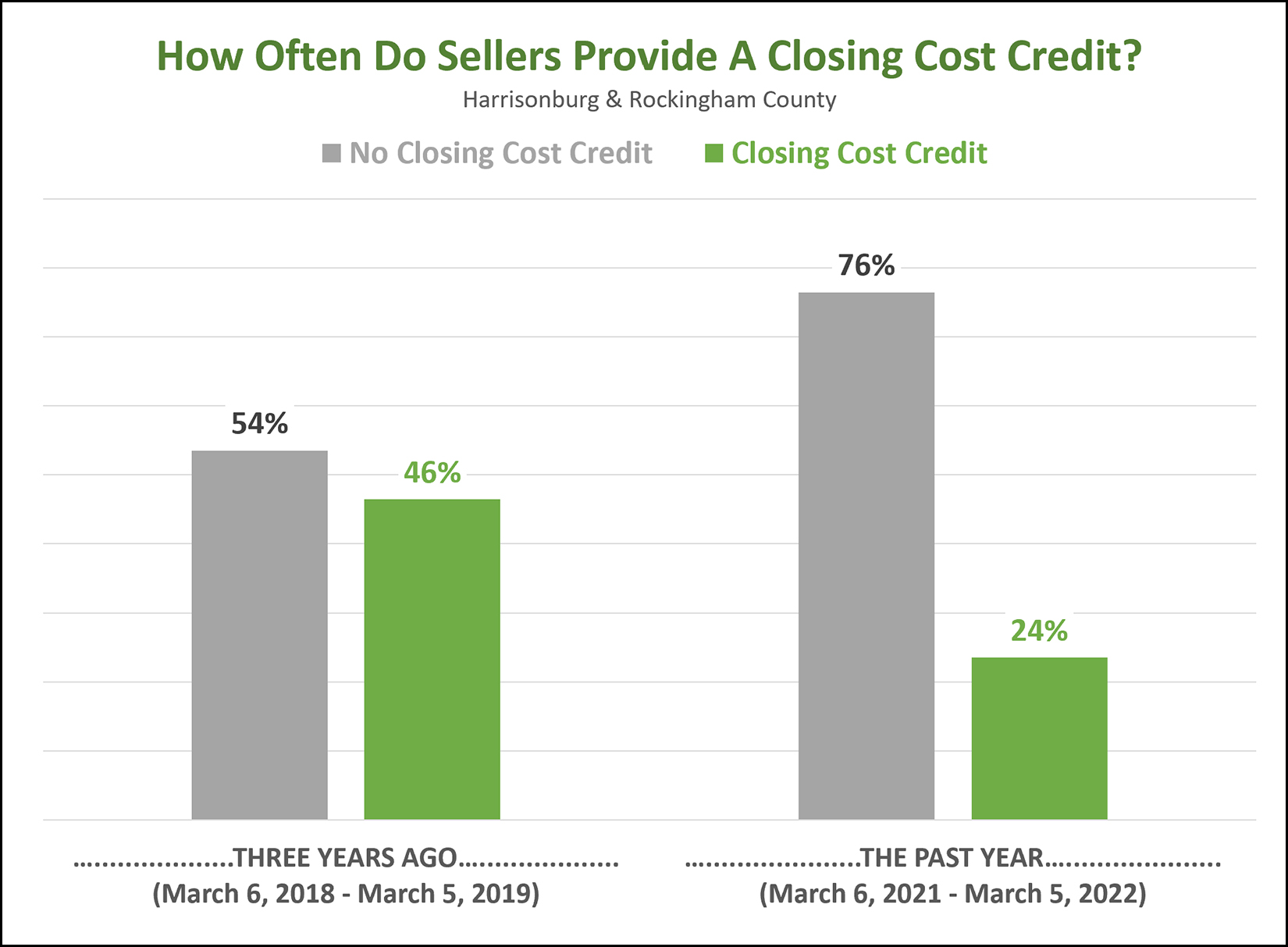 Sometimes a home buyers doesn't have all the cash on hand that they need for both a down payment and the closing costs. In that situation, sometimes a buyer might propose a higher sales price with the seller providing a closing cost credit at settlement. For example... instead of the buyer paying $240K for the house, they could pay $245K and the seller would give them a $5K credit back at closing. But... these days... that isn't happening as often. Three years ago sellers were giving closing cost credits to buyers in nearly half (46%) of all home sales in Harrisonburg and Rockingham County. These days, it is only happening about one in four times. Why might these types of transactions (with closing cost credits) not be happening as frequently right now? First, many or most sellers seem to gravitate towards buyers who have the strongest financial position (largest downpayment) as that is often an indication that they will be more likely to make it successfully through the contract contingencies (inspection, financing, appraisal) to settlement. Second, artificially increasing a contract price in order to have part of your closing costs included in that contract price will most often raise the bar as far as the the price for which the house will need to appraise. If presented with a $240K offer and a $245K less $5K offer, nearly all sellers will choose the $240K offer so that the house only has to appraise for $240K and not $245K. So... if you need a closing cost credit when buying a home... that's fine, it's still happening sometimes... but not nearly as frequently as it was in the recent past. | |
|
|
|
|
Is Your Escalation Clause Working The Way You Think It Will? |
|
 If you are making an offer on a house in 2022 there is a decent chance there will be other offers on the property as well. As such, you may find yourself considering the use of an escalation clause. What is an escalation clause, you might ask? An escalation clause allows you to offer one price but then to effectively increase your offer price to be above any other competing offers. Consider the following scenario on a house listed for $350,000
Offer 2 wins, right? If all the other terms were identical, then probably so. But if the first buyer didn't want to pay more than the asking price if they didn't have to -- but if they would have been willing to pay up to $360,000 -- then things could have worked out differently...
In this situation, Offer 1 becomes an offer of $352,000 and likely is the chosen buyer instead of Offer 2 which is then $1,000 lower. But let's add a layer here -- contingencies...
I see this type of scenario play out quite regularly. In many cases, the seller is will choose to move forward with Offer 2 - even though it is $1,000 less than Offer 1. Buyer #1 might have thought their escalation clause would do the trick and ensure they get to buy the property -- but that is not likely to occur. Why, you might ask? Buyer 2 seems to be better qualified to buy the home, with a larger down payment, plus they do not want to do a home inspection and they won't try to renegotiate after an appraisal. So, if a buyer has some other terms (financing, inspection, timing, etc.) that are possibly or likely to be less favorable to the seller, said buyer might consider leveraging their escalation clause a bit, such as the following...
In this scenario, Offer 1 becomes an offer of $356,000 compared to Offer 2 which is an offer of $351,000. This will cause the seller to think at least a bit longer and harder about whether they really want to go with Offer 2 that is more favorable from a contingency perspective. Think strategically when you are crafting your offer -- and your escalation clause -- knowing that a seller is looking at all of the terms of your offer, not just the offer price. | |
|
|
|
|
Lots Of Home Buyers Are Still Competing For New Listings |
|
 For many new listings, the competition is still quite fierce in Harrisonburg and Rockingham County. Here are three recent examples I've been involved with or heard of in the past 10 days... [1] A townhouse in the City of Harrisonburg under $200K received 12 offers within three days. [2] A duplex in the County in the $300K's received 7 offers within three days. [3] A detached home in the City of Harrisonburg in the $300K's received 16 offers within four days. Wow! Now, this won't be the case for every new listing, in every price range, in every location... there are more buyers in some price ranges and for some locations than others. This also won't hold true independent of how a seller prices their home. A home that ends up selling for $200K will likely have a different number of offers based on whether they priced the property at $195K, $199K, $205K or $225K. But... yes... the market is still quite active, with plenty of buyers ready to buy, and many (to most) new listings being scooped up quite quickly. If you're getting ready to sell this spring, we should talk sooner rather than later about timing, preparations, pricing and more. | |
|
|
| Older Posts |
Scott Rogers
Funkhouser Real
Estate Group
540-578-0102
scott@funkhousergroup.com
Licensed in the
Commonwealth of Virginia

Home Search
Housing Market Report
Harrisonburg Townhouses
Walk Through This Home
Investment Properties
Harrisonburg Foreclosures
Property Transfers
New Listings


