



| Older Posts |
 |
 |
How Much Have Home Prices Increased, Locally, When Adjusted For Inflation? |
|
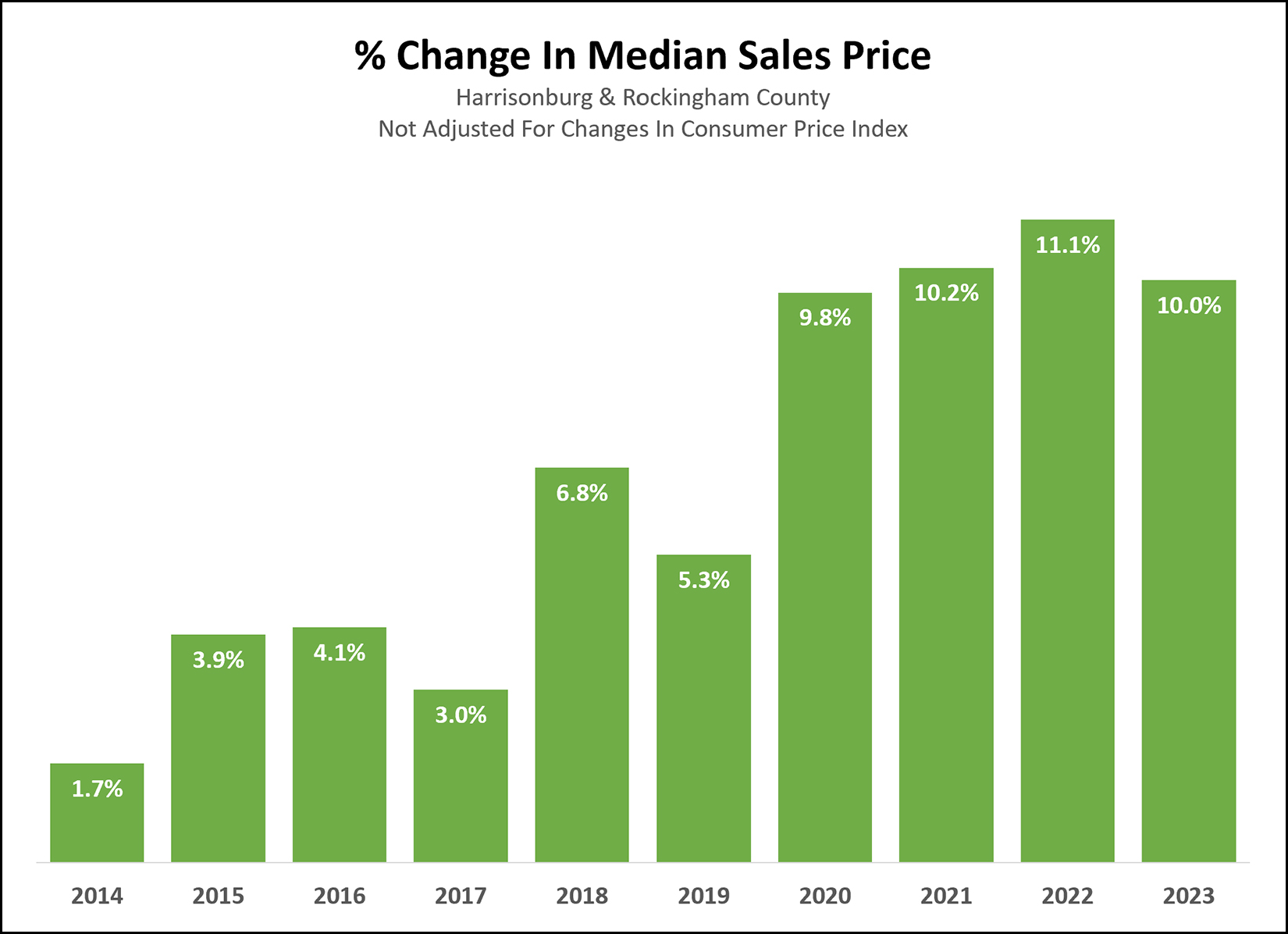 At first glance (above) the changes in the median sales price in Harrisonburg and Rockingham County have been CRAZY... with around 10% (or higher) increases in the median sales price every year since 2020. Wow! But... what if we adjust for inflation? The Consumer Price Index is the most widely used measure of inflation, and you'll see what the prices of most things have been increasing significantly over the past few years. Here's the change in CPI during the same timeframe as on the graph above... 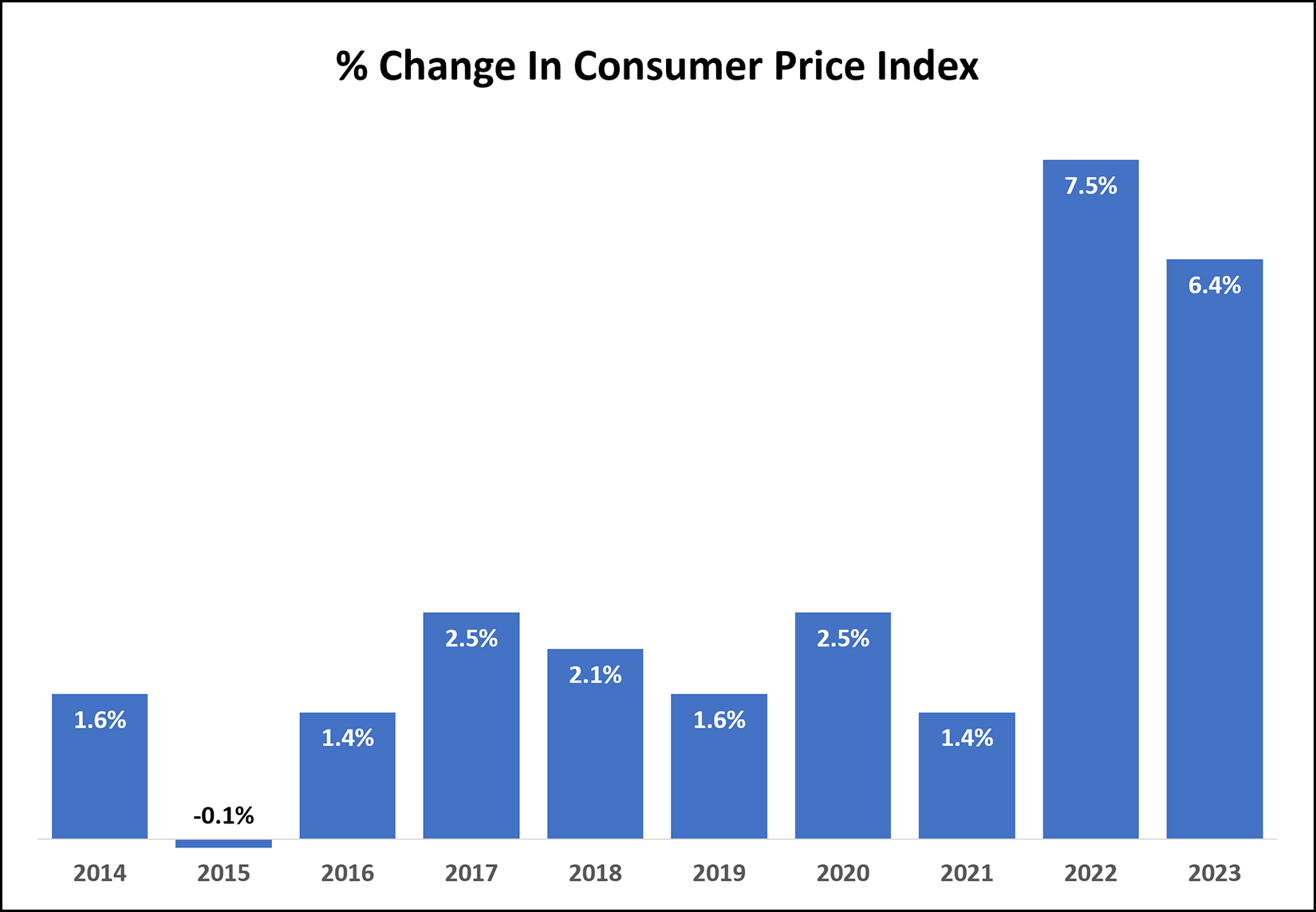 As you can see, there were some rather large increases in the Consumer Price Index during 2022 and 2023. Inflation, if you haven't heard, is real and larger than life. So, what happens when we subtract out the changes in CPI from the changes in the median sales price? Let's take a look... 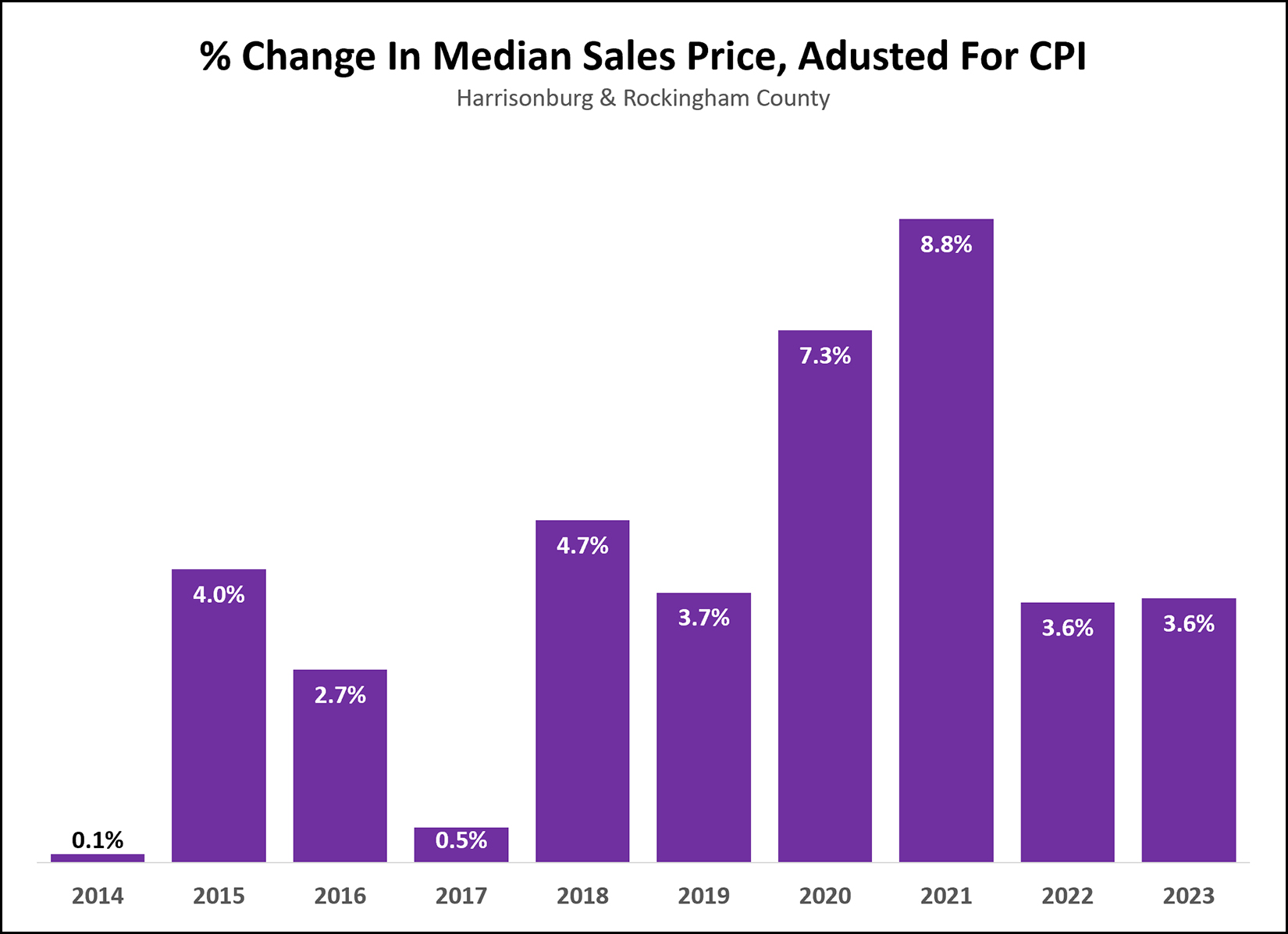 This graph starts to put the most recent price increases in a slightly different context. Yes, there were massive increases in the median sales price (when adjusted for inflation) during 2020 and 2021 -- which was in the midst of the Covid-19 pandemic. But when we adjust the median sales price (locally) for inflation (nationally) we see that the inflation-adjusted change in the median sales price over the past two years has been staying at 3.6%, not the 10% (+) increase we've seen in real dollars. But, yes, I know... you have to pay for a house with real dollars... and those real -- non inflation adjusted -- prices have been rising quickly. | |
 |
 |
|
|
Are Home Prices Only Going Up Because Mortgage Interest Rates Are Going Down? |
|
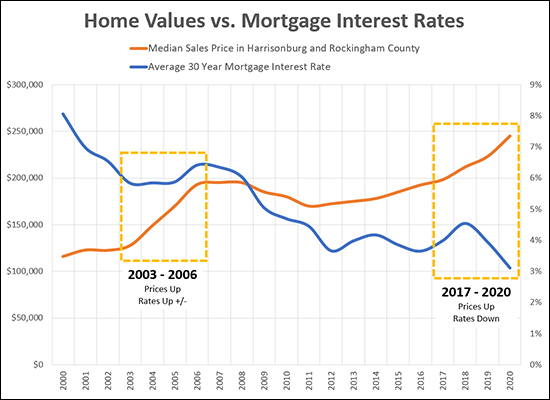 Disclaimer: I am not an economist. I don't play an economist on TV. Or on this blog. Feedback from actual economists, or accountants, or financial analysts, or wise guys is welcome: scott@hhtdy.com So, are home prices going up because mortgage interest rates are going down? Maybe yes AND no? Yes...
No...
So What...
Why...
| |
|
|
|
|
Mixed Use Developments in Rockingham County, Looking Around and Looking Forward |
|
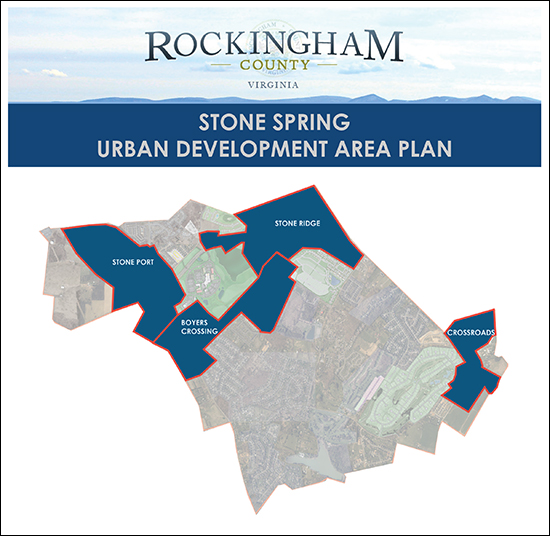 Given all of the developments popping up along Boyers Road it is probably a good time to pause and remember that this (Boyers Road) is one of the main areas where Rockingham County anticipates seeing further development in the years (and decades) to come per the Stone Spring Urban Development Plan. The Stone Spring UDA provides a blueprint for the potential development based on a traditional town pattern in four geographic areas that they have called Stone Port, Stone Ridge, Boyers Crossing and Crossroads. Here's the big picture, per Rockingham County... "The UDA Plan presents a vision for the development of new, walkable mixed-use neighborhoods, within the four neighborhood focus areas while preserving existing neighborhoods." "Plans and development scenarios are conceptual and would be phased over the ensuing 20 years, contemplating future generations of development and adaptive reuses of certain parcels over that period. Recommended conceptual alignments, structures and functional uses do not account for parcel boundaries or topographic constraints." One main thing to note here is that the County has a vision of these four areas being developed as mixed use developments. We can think about this most simply as residential and non-residential uses. Non-residential uses might be office space or retail, etc. This type of development (mixed use) will look and feel different than most of the areas that folks are familiar with in Harrisonburg and Rockingham County because there are not many mixed use developments currently in existence in our area. A few examples and non-examples... Crossroads Farm could sort of be seen as almost being a mixed use development in that a bank was built at the corner of the neighborhood where Cross Keys Road and Spotswood Trail intersect. That's probably a bit of a stretch though, as these two areas (residential neighborhood, bank) do not connect for vehicular or pedestrian traffic. Urban Exchange is a mixed use development in downtown Harrisonburg (yes, in the City, not the County) because it has apartments over top of retail and office space, though it is all in one connected building, as opposed to a mixed use development in multiple buildings spread out over a tract of land. Preston Lake was always intended to be a mixed use development with commercial space on the edge of the original development plan, and as a part of the current development plan, but it's only a residential development thus far with detached homes, duplexes, townhomes and now an adjacent apartment complex under construction. Again, all residential development - though there is still a possibility it will have some non-residential development as a part of it at some point in the future. Stone Port, located catty-corner to Sentara RMH Medical Center would seem to be one of our area's first mixed-use development, because it has residential uses (apartments) and non-residential uses (retail, office, etc.) Stoney Ridge is a proposed/planned mixed use development on the south end of Harrisonburg and partially in the County. It would almost entirely be residential development (apartments, townhouses, duplexes, detached homes) but does have some intended commercial lots on the front of the property. Boyers Crossing is a proposed mixed use development on the corner of Boyers Road and Port Republic Road including apartments, commercial space and storage units. More on this in the coming days. Am I missing any current or proposed mixed use developments? If so, email me. I suspect we will continue to see further proposals for mixed use developments in the four areas in the County referenced above. Perhaps as further mixed use developments take shape we will become more accustomed to them and more comfortable with them in this marketplace. | |
|
|
|
|
The Movie Theater (Regal Cinemas) In Harrisonburg Is Closed, Permanently |
|
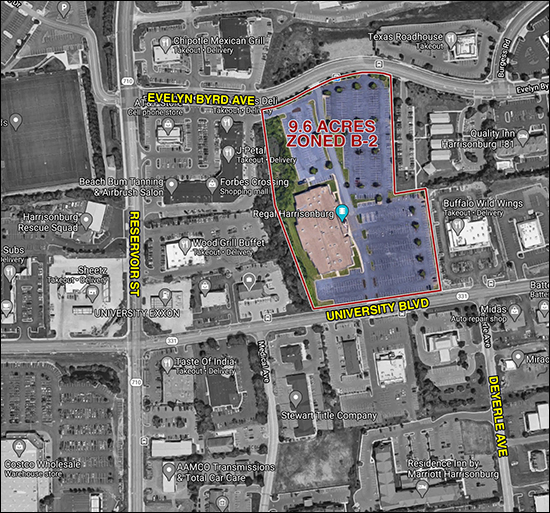 So much for catching the latest new movie on the big screen!?! The 9.6 acre parcel shown above - known to us as Regal Cinemas plus its very larger parking lot - is now owned by Armada Hoffler Properties. It would seem the tenant of the property (Regal Cinemas) defaulted on their lease and thus the company (Armada Hoffler Properties) terminated the lease. This shouldn't be an enormous surprise as the movie theater closed this past spring due to COVID and its parent company has ceased operating all theaters across the country earlier this month. But... it seems that this 9.6 acre property will not be sold... the owner of the property plans to redevelop the property. I assume this means they will tear down the building and build a much larger mixed use development, as the majority of the land is currently used for parking. Read more about this over at The Citizen... | |
|
|
|
|
Monthly Housing Cost for Median Priced Home Climbs Further in 2019 |
|
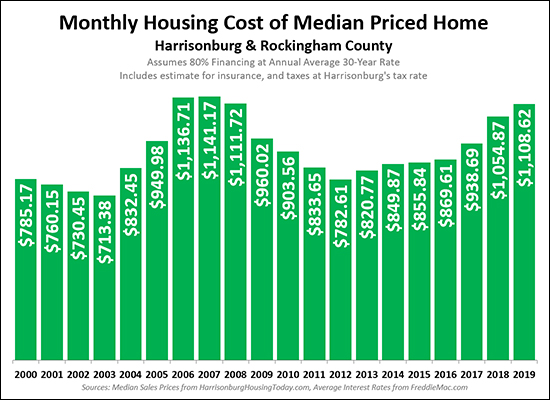 As should come as no surprise, the monthly cost of housing is increasing -- and has been increasing more quickly over the past several years (2018, 2019) as compared to many prior years. The graph above devises a monthly cost of housing using the median sales price of homes sold in Harrisonburg and Rockingham County and the mortgage interest rate at the time. The payments above assume that a buyer finances 80% of the purchase price at the prevailing rate -- and these housing costs include an estimate of real estate taxes and homeowners insurance. Of interest -- this monthly cost...
Over the next few years, it seems likely we will see a continuation of this trend, as sales prices and mortgage interest rates are both likely to continue to increase. | |
|
|
|
|
50 Largest Employers in Harrisonburg Rockingham MSA |
|
 Looking for a job? Or trying to understand the types of employment offered in the Harrisonburg and Rockingham County area? Below is a list of the 50 largest employers in the Harrisonburg Rockingham Metropolitan Statistical Area per the Virginia Employment Commission as of 2019-Q2. Highlights: Higher Education, Healthcare, Public Schools, Distribution, Poultry, Publishing, Hospitality, Manufacturing and more!
| |
|
|
|
|
Mixed Use Development Proposed on Peach Grove Avenue |
|
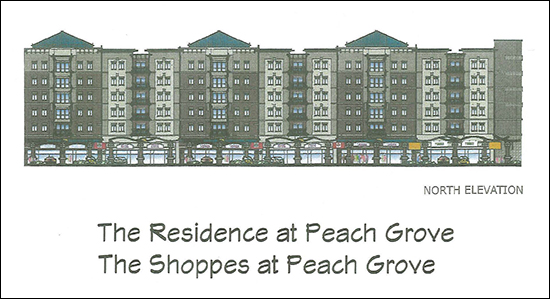 The Harrisonburg City Council will hold a Public Hearing on May 14, 2019 at 7:00 PM on a variety of topics, including the potential rezoning of land on Peach Grove Avenue for the development of "The Residence and Shoppes at Peach Groves". UPDATE: The applicant has tabled the request until May 28. The public hearing will not take place on May 14. 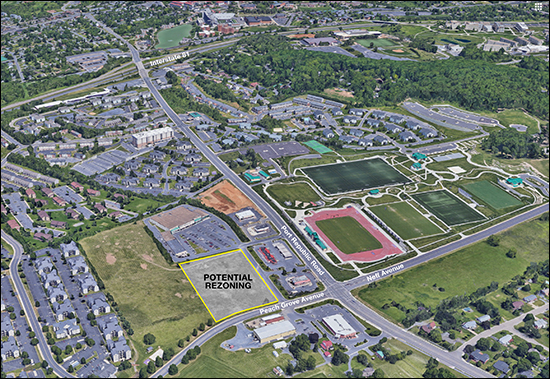 Here are some key points to know based on the information packet provided during the Planning Commission meeting in April.
If you want to provide input on this potential rezoning for this potential development, attend the City Council meeting on May 14, 2019 at 7:00 PM. UPDATE: The applicant has tabled the request until May 28. The public hearing will not take place on May 14. | |
|
|
|
|
Merck Announces $1 Billion Investment in Elkton, Virginia Facility, Over Three Years, To Create 100 Jobs |
|
 In a major employment announcement for Rockingham County, Virginia Governor Ralph Northam announced yesterday that Merck will be investing up to $1 Billion over the next three years to expand its manufacturing facility in Elkton, Virginia and create a new Gardasil Purification Center. This growth will add up to 100 new jobs and 120,000 square feet to the Elkton facility. Here's an excerpt from this report from NBC29... "As part of the expansion, Blue Ridge Community College (BRCC) and James Madison University (JMU) will collaborate to address Merck's short- and long-term workforce needs through the development of a custom workforce solution. BRCC and JMU will establish a pipeline of biotechnology engineering and computer science talent that will allow the Shenandoah Valley to accommodate the future growth of Merck and other life science industries and manufacturers in the region." Read more via this article at NBC29... Governor Northam Announces Significant Investment in Rockingham County Merck & Co., Inc. to expand Elkton manufacturing facility, creating about 100 new jobs. | |
|
|
|
|
Harrisonburg, The City With The Planned Future, Plans Their Future |
|
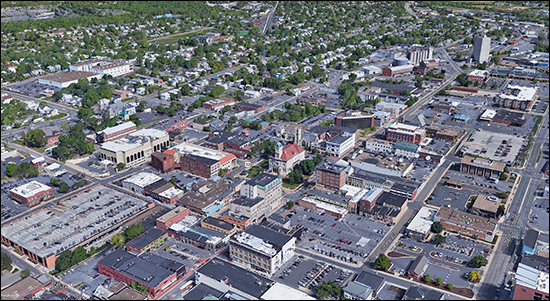 City Council members and top City administrators and planners invested time in planning a future for the City of Harrisonburg at a three day retreat last weekend, with an eye towards Harrisonburg 20 years from now -- in 2039. That vision includes establishing Harrisonburg as the "capital of the Shenandoah Valley". Extensive conversations took place about education (including the new high school) and a comprehensive housing plan (including affordable housing and homelessness). Read much, much more about the retreat, conversations, outcomes and priorities over at The Citizen... If you care about the future of the City of Harrisonburg, read the article above, and give some thought to how you can be an active part of making the future of Harrisonburg brighter. | |
|
|
|
|
Foreclosures Slow Considerably in 2018 |
|
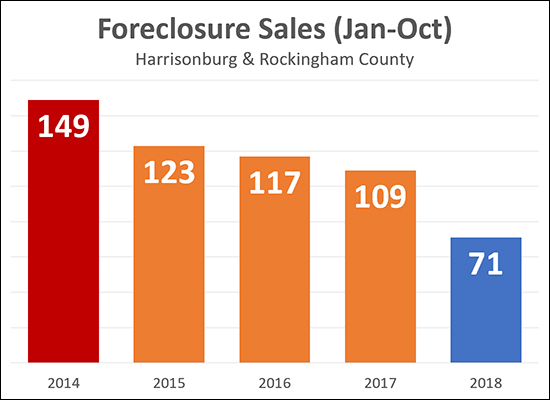 Fewer and fewer homeowners are finding themselves in a situation where they are being foreclosed on in Harrisonburg and Rockingham County. The data above reflects the number of completed foreclosure sales in the first ten months of the year for each of the past four years as well as the current year. The number of foreclosures (in the first 10 months of the year) has fallen 35% over the past year -- and an astonishing 52% from where we were four years ago. This is likely a result of rising home values, leaving fewer homeowners in a situation where they cannot sell their home if they are no longer able to make their mortgage payments. | |
|
|
|
|
Harrisonburg City Council Considering Regulating Short Term Rentals |
|
 Do you have an opinion on whether short term rentals (such as via AirBNB) should be permitted and/or regulated in the City of Harrisonburg? If so, you should show up on Tuesday, September 11th for the public hearing on the topic. More from today's Daily News Record article...
| |
|
|
|
|
Where Will Recent JMU Graduates, Staying In Harrisonburg, Buy Houses? |
|
 It's a numbers games, folks.... Some percentage of each graduating class at JMU (and EMU, and Bridgewater College) will decide they want to stay in Harrisonburg and make it their home. These three institutions seem to graduate around 6,000 students each year. How many might decide to stay in Harrisonburg? In chatting with several folks about this yesterday, I pondered aloud whether enough new "for sale" housing is being built for recent grads to buy, once they decide they want to stick around and buy a home. Or, more broadly, is our housing stock growing as fast as our population. I suspect that it is not -- based on how quickly homes are selling and how low our inventory levels remain month after month. So, what are these recent (within the past few years) JMU grads to do? Perhaps make several offers on several properties, missing out on most because of multiple offer situations, and then eventually securing a contract to buy a home. Or, perhaps they just rent because there is so little to buy. But if many or most of them do rent, it is -- at least in the short term -- a net loss for our community. If they buy a home, they will be putting down roots, committing to stay in the area, investing even further in our local economy, etc. If they are renting, not so much on any of those fronts. Not so long ago (ok -- fine -- 16 years ago) I was a recent JMU graduate -- having just finished up my master's degree -- and my wife (fiancé at the time) and I decided we wanted to stay in this area. We were able to find a townhouse to buy, and were excited to make this our home. The landscape now, at least for recent graduates buying homes, is a bit different. | |
|
|
|
|
Owners of median priced City homes might have to pay $26 more per month to fund new City high school |
|
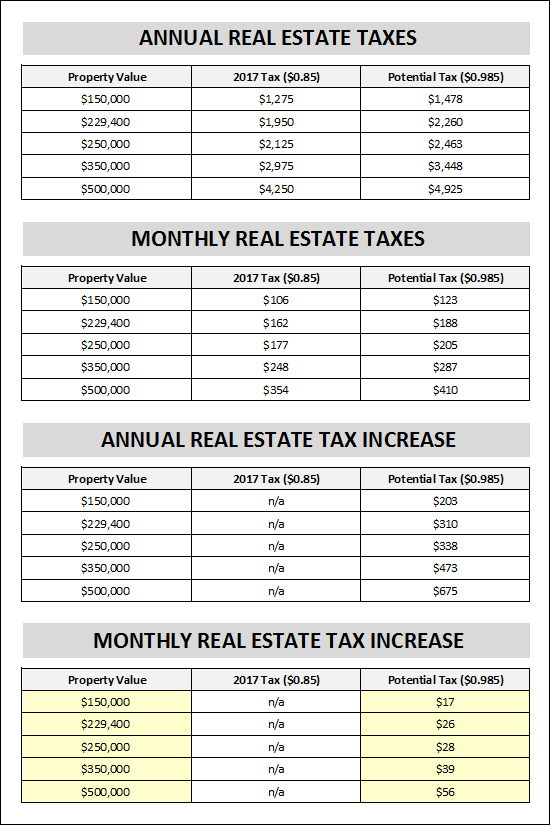 Numbers are funny. All of these statements are true based on current projections:
I'm guessing that if you ask most parents of school aged kids in the City if they'd be willing to pay $26 per month such that their child would not be in an overcrowded, not-so-ideal, learning environment for high school, they'd likely be quick to say yes. That said, this $26 per month increase would need to be paid for 25 years -- but for a parent of a child in the school system, I'm guessing that would still seem to be a reasonable cost. I'm also guessing that City property owners who do not have children in the local school system would LOVE for their property taxes to NOT increase. And I'll even go a step further -- I am guessing that they don't really want school aged children to have an overcrowded, not-so-ideal, learning environment -- it's probably just more about the increased tax burden. Anyhow. Numbers are funny. Read today's Daily News Record article, and feel free to form your own opinions. There seem to be plenty of them circulating through our community about this topic. :) | |
|
|
|
|
Realtor Association and Madison Center for Community Development Publish Local Housing Needs and Market Analysis |
|
 The Harrisonburg-Rockingham Association of Realtors and the Madison Center for Community Development recently (Nov 2016) published a Housing Needs and Market Analysis of the Harrisonburg and Rockingham County area. There is a LOT of data, analysis and insight in this report -- so feel free to download and read it if this is of interest to you -- or I'll bring some further highlights from it to my blog in the near future. Download the report here. | |
|
|
|
|
Make your voice heard in the updated Comprehensive Plan for the City of Harrisonburg |
|
 The City of Harrisonburg is in the midst of updating the Comprehensive Plan for the City. As per the City.... The Comprehensive Plan presents a vision of Harrisonburg's future. It identifies steps to move toward that vision by providing information about current conditions, long-term goals and objectives, and recommended implementation strategies. As described in the Code of Virginia, the Comprehensive Plan is general in nature. Harrisonburg's Plan addresses a wide range of issues including but not limited to: land use, housing, education, transportation, recreation, the preservation of historic and natural resources, and economic development. The plan serves as a long-term guide for the community, and it helps City leaders with setting policies and decision-making. So, basically, what do you want the City of Harrisonburg to be in 10 or 20 years? Discussions taking place and decisions being made right now will affect that future, and you have the opportunity to be a part of the conversation! Better yet -- there are several Public Workshops coming up that will allow you to chime in on topics near and dear to your heart.... Education; Arts, Culture, and Historic Resources; and Community Engagement & CollaborationSo, mark your calendars, and get involved in the discussions and decisions to help shape the future our our great City! Also of note.... Lots of Q&A's about the Comprehensive Plan update can be found here. General information about the Comprehensive Plan update can be found here. | |
|
|
|
|
New Starbucks location (with drive thru) coming to Port Republic Road, 1250 feet from existing Starbucks |
|
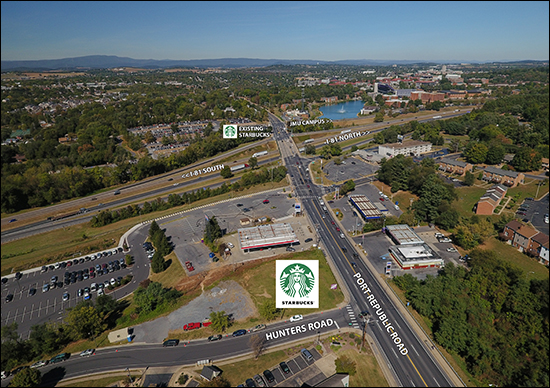 Click here for a larger version of the map shown above. As reported in this past Saturday's Daily News Record -- a new Starbucks location will be constructed at the Intersection of Port Republic Road and Hunters Road, on a currently vacant lot. A variety of additional details and thoughts....
| |
|
|
|
|
New Developments Coming Soon? |
|
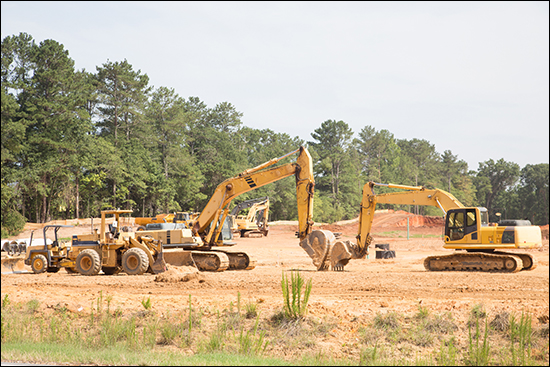 Three parcels of development land (see below) are now under contract. Perhaps we'll be seeing some new developments taking shape in and around Harrisonburg soon? 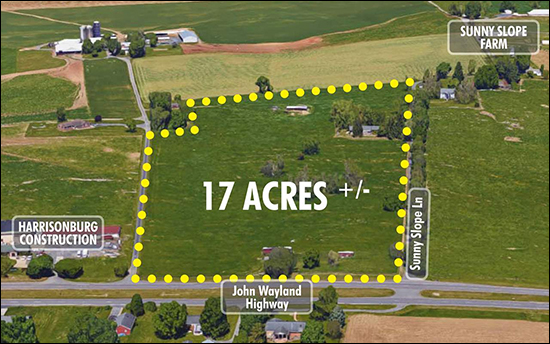 2112 SUNNY SLOPE LN, ROCKINGHAM, VA - 16.91 ACRES - $1,039,000 This nearly 18 acre tract of land is just outside the City of Harrisonburg and offers an opportunity to develop for residential and/or commercial use, subject to rezoning. The property is located on Route 42 with about 450 feet of road frontage near WalMart and beside Harrisonburg Construction. There are three parcels, two currently zoned A2 and one zoned R2. Water & Sewer is available. The property includes a 3,000 sf ranch style residence with a basement and was built in 1960. UNDER CONTRACT SINCE 3/2/2017. 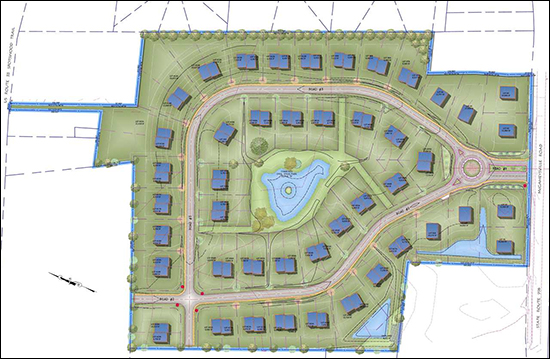 9447 MCGAHEYSVILLE RD, MCGAHEYSVILLE, VA - 21.76 ACRES - $1,250,000 Temporary Price Cut for an Early April Closing! Extraordinary Opportunity! A fully approved Residential Subdivision in McGaheysville and ready to be developed. The site is approved for 84 units (6 single family & 39 duplex lots). It can be constructed in Phases. Full views of Massanutten and the Blue Ridge Mountains. The subdivision includes a roundabout, internal loop road for walking, and riding, a shared access pond/park area. County water & sewer. UNDER CONTRACT SINCE 7/5/2017. 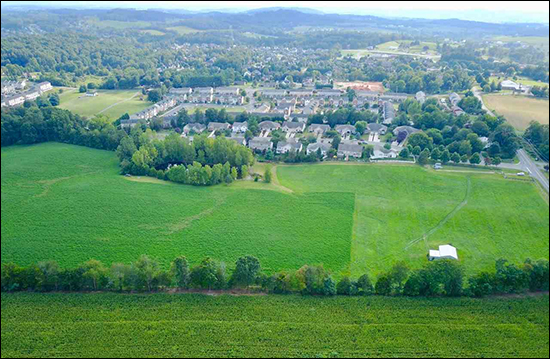 TBD BOYERS ROAD, ROCKINGHAM, VA - 26.27 ACRES - $2,365,000 Prime Development Land. 26 + Acres Zoned R3 on the east side of Harrisonburg on Boyers Road across from Sentara RMH Hospital. Property borders the Massanetta Springs Camp & Conference center property on the east and also has a pond that has water in it most of the year. Could be a great duplex or townhouse development. There is a small barn on the property. UNDER CONTRACT SINCE 9/11/2017. | |
|
|
|
|
Harrisonburg could never have enough student housing! |
|
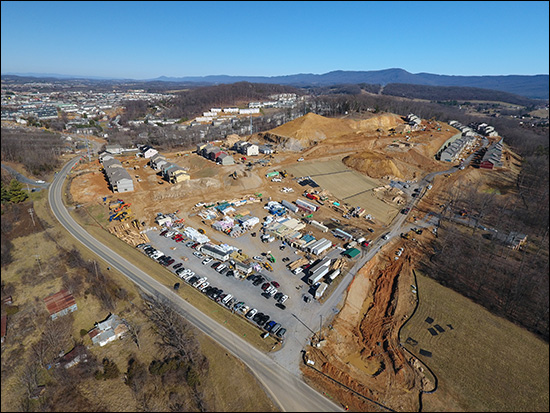 OK, OK, that's probably not true -- Harrisonburg probably does not have an infinite need for student housing. Just consider my title, then, to be an intro to all of the alternative perspectives that have been shared with me since I wrote these two posts.... Does Harrisonburg need more Off Campus Student Housing? Does New College Student Housing Increase the Demands on Local Elementary Schools? OK -- here goes -- all the reasons I might be wrong, and all of this new student housing might be OK, or even a good thing.... 1. JMU is growing! All of this student housing is necessary -- JMU is continuing to grow, and they are not building on campus fast enough for their growth, so the private sector must build and rent housing to students in order to meet that growing demand. 2. Denying growth just pushes it elsewhere. If the City decided to stop permitting new student housing communities to be built, that would just push developers to build them in the County, or push students to live in otherwise owner occupied neighborhoods. 3. This is an affordable way to get workforce housing. There isn't much truly affordable rental housing being built -- and older student housing complexes being effectively turned into workforce housing by virtue of students being attracted to new student housing communities is not necessarily a bad thing. It may be the most affordable way to create affordable or workforce housing. 4. Bring on the wrecking ball. If even more student housing is built, the rental rates will fall even lower on the oldest complexes, devaluing those properties to the point where it will make sense to just knock them down and build new housing -- thus, eliminating the older, outdated housing. 5. How much regulation do you want "the government" to do? If the government (planning commission, city council, staff) should start making judgement calls about how much student housing is too much student -- and thus regulating what landowners (and student housing developers) can and cannot do -- should they also start governing other segments of the private sector? Should they regulate how many hair salons exist? How many banks are permitted to operate? How many restaurants can open? How many Realtors can sell homes? :) OK -- again -- I don't necessarily agree with all of the perspectives above, but I believe it is important to consider these counterpoints when thinking about how our community should be planning for the future as it pertains to student housing, land use, property taxes, schools, etc. And, as I mentioned to a reader in response to their comments.... I don't know if new student housing projects should or should not be denied - but I think the local community needs to fully understand the impact of continuing to approve more student housing communities. If older student housing communities become workforce housing, great, no problem -- but let's realize that this is the result of approving new student housing communities, and make sure that infrastructure (schools, for example) are in place for the new workforce housing that we have indirectly created. | |
|
|
|
|
Complete the Harrisonburg Retail Survey Today! |
|
 Take a few minutes to fill out this 19-question survey about the Harrisonburg area that will ask you about yourself, your internet use and our shopping habits. This survey is being used to determine what gaps exist in what is being provided by local retailers, with the hopes of using the data to attract further retailers to our area and to enhance existing businesses. Read on from the Daily News Record.... Survey Seeks Data To Lure Retailers | |
|
|
|
|
Harrisonburg Population Up 11% Over Six Years |
|
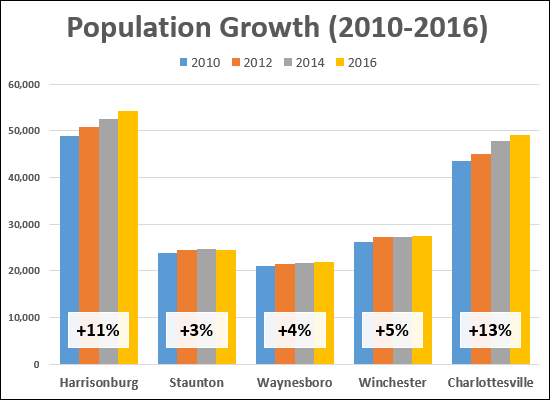 As shown above, the population of the City of Harrisonburg has increased by 11% over the past six years to it's current (estimated) level of 54,224. A few other fast facts from today's Daily News Record article....
Read the full Daily News Record article for much more context and insightful commentary. | |
|
|
| Older Posts |
Scott Rogers
Funkhouser Real
Estate Group
540-578-0102
scott@funkhousergroup.com
Licensed in the
Commonwealth of Virginia

Home Search
Housing Market Report
Harrisonburg Townhouses
Walk Through This Home
Investment Properties
Harrisonburg Foreclosures
Property Transfers
New Listings


