



Preservation
 |
 |
Grace Street Project Community Design Charrette |
|
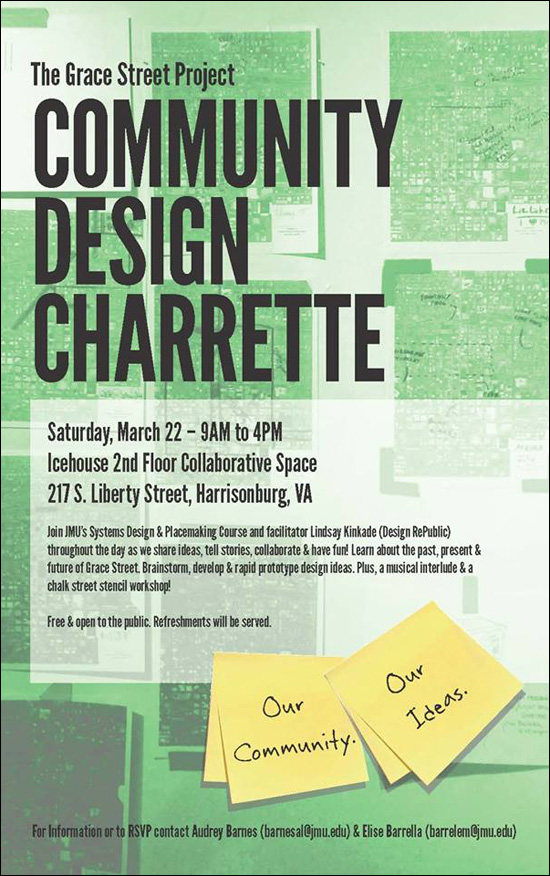 Are you interested helping to re-imagine what Grace Street might look like in an ideal context? Join stakeholders from the community (residents, government, leaders, etc.) alongside JMU students, staff and faculty for the Grace Street Project Community Design Charrette. Grace Street Project Community Design Charrette Saturday, March 22, 9:00 AM - 4:00 PM Icehouse 2nd Floor Collaborative Space 217 S. Liberty Street, Harrisonburg, VA You will be joining JMU's Systems Design & Placemaking Course and facilitator Lindsay Kinkade (Design RePublic) throughout the day in sharing ideas, telling stories, collaborating and having fun! Learn about the past, present and future of Grace Street. Brainstorm develop and rapid prototype design ideas. Plus, a musical interlude and a chalk street stencil workshop! Free and open to the public. Refreshments will be served. For Information or to RSVP contact Audrey Barnes (barnesal@jmu.edu) or Elise Barrella (barrelem@jmu.edu). | |
 |
 |
|
|
Size Distribution of Rockingham County Land Parcels |
|
Rockingham County, Virginia (not including the City of Harrisonburg) is comprised of (approximately) 46,600 parcels of real estate. Some of these lots or tracts are very small, in towns such as Grottoes, Dayton or Elkton. Others are quite expansive and are in the far flung corners of the County. Below is a visual representation of the distribution of lot sizes of those 46,600 properties --- you might need to click on this link to view the full size document for easier reading. Here's the summary:
| |
|
|
|
|
Call To Action > > > Save Lake Shenandoah |
|
 From today's Daily News Record, Lake Shenandoah, a.k.a. "Shen Lake," needs to be saved! Some key points of this story include: From today's Daily News Record, Lake Shenandoah, a.k.a. "Shen Lake," needs to be saved! Some key points of this story include:
Again --- read the full story here --- or contact: Steve Reeser, Fisheries Biologist Virginia Department of Game and Inland Fisheries (540) 248-9360 reesers@dgif.state.va.us | |
|
|
|
|
Will Rockingham County Be Paved Over? |
|
I have heard some people talk about development as if in the next few years, or decades, all of Rockingham County will be developed --- with the farm land destroyed, and our history no longer preserved. Below I'll try to put that thought in the context of actual land use, but for the record --- I don't think many at today's Smart Growth Symposium thought that the above statement is true. (Lest anyone conclude that I am referring to any of the attendees). 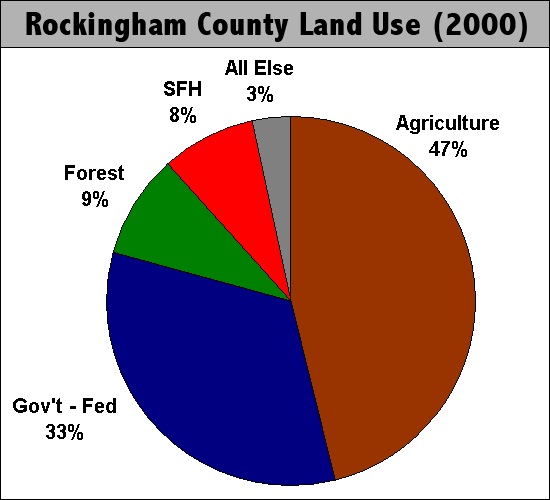 The data above is extracted from the Rockingham County Comprehensive Plan, particularly page 18 of the section on Strategies, Policies and Actions. Here's the full list of how Rockingham County land is being used:
| |
|
|
|
|
Smart(er) Growth For Harrisonburg and Rockingham County? |
|
Wow! Today's Smart Growth Symposium, orchestrated by the Shenandoah Valley Builders Association was a fantastic primer on growth issues and how to plan for them in the central Shenandoah Valley. Stewart Schwartz, the Executive Director of the Coalition for Smarter Growth, provided a great overview of smart growth principles and policies that provided a helpful framework for thinking about and planning for the future of our area. One key point that he made, that stuck with me, was a need to focus on developing in the right place. Those present included conservationists, builders, farmers, real estate agents, bankers, local planning staff, elected officials, engaged citizens, and more. There seemed to be a great desire for and capacity to consider working together for the best future for our valley, despite the varying perspectives each of us bring to the table. | |
|
|
|
|
Builders Association To Hold Smart Growth Symposium |
|
The Shenandoah Valley Builders Association will hold a Smart Growth Symposium on Friday, February 22, with registration at 9:30 AM and finishing around 3:30 PM. This event will be an opportunity for members of the community to come together to learn about issues related to growth from a variety of perspectives, and to participate in a public conversation on the future of the Shenandoah Valley. The schedule of speakers and topics is as follows: 10:00 AM - Stewart Schwartz, Coalition for Smarter Growth Addressing the topic, "The Smart Growth Option" 11:45 AM - Lunch served 12:30 PM - Question & Answer session for panel of guests:
Addressing the topic "What is a Comprehensive Plan?" This should be an informative day with a variety of opinions and perspectives. The cost is $10 per person and includes lunch, and the deadline to RSVP is by Wednesday, February 20. Reservations and payment can be made online. | |
|
|
Scott Rogers
Funkhouser Real
Estate Group
540-578-0102
scott@funkhousergroup.com
Licensed in the
Commonwealth of Virginia

Home Search
Housing Market Report
Harrisonburg Townhouses
Walk Through This Home
Investment Properties
Harrisonburg Foreclosures
Property Transfers
New Listings


